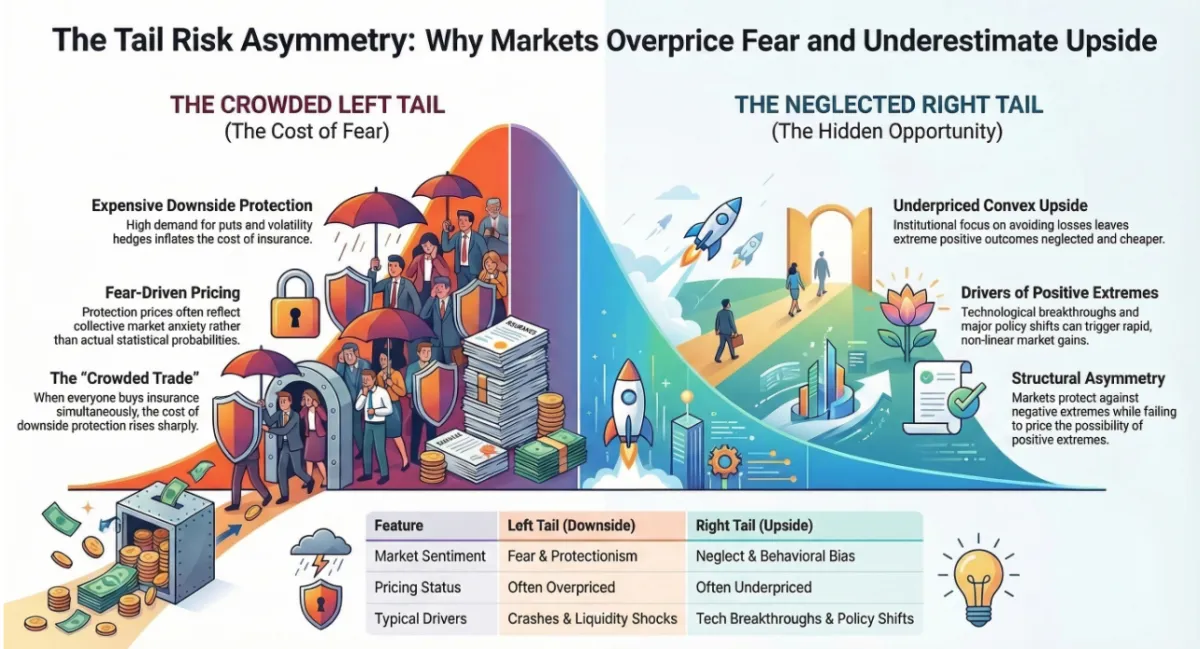
The Expensive Cost of Market Fear
The Expensive Cost of Fear: Why the "Right Tail" Is the Market’s Most Overlooked Opportunity
Introduction: The Gravity of the Crash
In the high-stakes theater of global finance, the most scrutinized object in the room isn't the stage, it is the glowing red "Exit" sign. Investors spend their careers scanning the horizon for the next systemic shock, the next liquidity freeze, or the next black swan. This collective fixation on "tail risk" almost exclusively targets the Left Tail: that dark corner of the probability distribution where catastrophic losses reside.
Yet, while the instinct to survive a crash is foundational, this obsession creates a profound structural amnesia regarding the rest of the curve. By crowding toward the exit, market participants often abandon the most fertile ground in the room. The "Right Tail", representing extreme, non-linear positive outcomes, is frequently left unattended. In our haste to insure against disaster, we have inadvertently created a marketplace where the greatest opportunities are found not in what we fear, but in what we have forgotten to imagine.
Takeaway 1: When Insurance Becomes a Crowded Trade
Risk management is a necessity, but it is also a commodity subject to the brutal laws of supply and demand. When the fog of geopolitical friction thickens or macroeconomic data turns cold, the rush for downside protection transforms into a frantic, crowded trade.
The irony is that as capital surges into defensive instruments, the cost of protection often detaches from statistical reality. We see this in the "panic premium": a state where implied volatility vastly outstrips realized volatility, or the actual movement of the market. Investors find themselves overpaying for a safety net that is priced for a magnitude of disaster that rarely materializes.
"When demand for insurance rises sharply, the cost of that insurance rises as well. Out-of-the-money puts, volatility exposure, and structured hedges can become increasingly expensive as capital crowds into the same trade." Paying for this protection is frequently more a behavioral ritual than a rational calculation. When the herd buys insurance at any price, the Left Tail becomes the most expensive real estate in the market.
Takeaway 2: The Structural Blind Spot of the "Right Tail"
The systematic neglect of extreme positive outcomes isn’t an accident; it is a byproduct of how modern finance is built. Three primary forces drive this imbalance:
● Behavioral Bias: We are evolutionarily hardwired to feel the sting of a loss twice as intensely as the joy of a gain. Fear is a louder signal than hope.
● Narrative Dominance: The financial press thrives on "the end of the world" scenarios. It is far easier to sell a story about a coming collapse than a nuanced thesis on a convex breakthrough.
● Institutional Incentives and Career Risk: This is the most potent driver. For a professional portfolio manager, the reward structure is fundamentally asymmetric. Missing a 20% market rally is a "shame" that results in a smaller bonus; however, a 20% drawdown is a "firing offense." This "herding mentality" is a rational survival strategy for the individual, even if it results in irrational pricing for the client’s capital.
Because managers are incentivized to protect their careers by avoiding the Left Tail at all costs, their defensive positioning leaves the Right Tail structurally under-researched and under-owned.
Takeaway 3: Convexity and the Underpriced Upside
The Right Tail is defined by extreme positive outcomes driven by nonlinear events: technological leaps, radical policy pivots, or sudden economic accelerations. These are not the slow, grinding gains of a standard bull market. These shifts create "convex" price movements. A small change in market perception leads to an exponential move in price. When the crowd is busy overpaying for downside puts, this "upside convexity" can become accidentally inexpensive. This is the realm of "accidental alpha." It occurs because the market has concentrated its capital into a single, defensive narrative.
While a positive tail event is never guaranteed, the mathematical payoff of these possibilities becomes highly favorable when the cost of entry is suppressed by collective neglect.
Takeaway 4: Beyond One-Sided Risk Management
Sophisticated risk management requires acknowledging the full shape of the distribution, not just the parts that cause anxiety. There is a recurring irony in the markets: the most valuable insights are rarely found where the crowd has gathered with their binoculars. True edge is found in the gaps, the places where attention is missing because everyone is looking the other way. When capital crowds into a single fear-driven narrative, pricing imbalances are inevitable. By recognizing that the "price of safety" has been bid up to irrational levels, an astute observer can pivot toward the overlooked side of the curve.
"Sometimes the most interesting insights about risk are found not where attention is concentrated, but where it is missing."
Conclusion: Rethinking the Curve
Navigating today’s volatile landscape requires more than just a sturdy shield; it requires the vision to see the opportunities that fear has obscured. While the Left Tail represents the risks that keep the world awake at night, the Right Tail represents the breakthroughs that the market has simply forgotten to price.
As you recalibrate your positioning, ask yourself: Is your portfolio a fortress built on the expensive bricks of collective fear? By daring to look at the "other side" of the probability distribution, you may find that the most significant breakthroughs are the ones that no one else is willing to pay for.
Stay Systematic, Stay Prepared, and Stay Ahead.

